Admissions Blog

Undergraduate Admissions Uncensored

  • admissions.blog

New University of Virginia Supplemental Essay Question for 2023-2024 Admissions Cycle

Posted on July 19, 2023 by Craig Meister 9 Comments

University of Virginia has revealed its new required short essay question for first-year applicants during the 2023-2024 admissions cycle, and unlike questions asked in past years, this one is quite a head-scratcher.

All first-year UVA applicants must complete an essay in up to 300 words responding to this new prompt:

What about your background, perspective, or experience will serve as a source of strength for you or those around you at UVA?

Those students applying to UVA’s School of Nursing also are being asked to respond to this prompt in no more than 250 words:

Describe a health care-related experience or another significant interaction that deepened your interest in studying Nursing.

The new required question for all applicants is clearly leading in nature and developed by committee in order to elicit responses that highlight prospective students’ diversity; yet, the way in which the question is being asked seems somewhat complex while also opening applicants – and the university itself – to a number of challenges.

Most notably, applicants need to balance describing a particular background, perspective, or experience AND how it will strengthen them or will strengthen others during their time at UVA. That’s a lot to ask for in 300 words and still expect to get much depth.

Many perspectives and experiences require quite a bit more than one sentence to describe, which will leave limited space to elaborate upon how such a perspective or experience will strengthen the student or others if and when the student arrives on campus. This may lead many applicants to opt to focus on their background instead of a perspective or experience, but those who do will need to focus less on the background and more on how it has served to date or will serve in the future as a source of strength for them or others.

One wonders why UVA doesn’t just ask a far more user-friendly question like, “What lesson from your past will help you thrive in or give back to the UVA community?” A potential reason that students are not getting a clearer or more direct question this cycle may be because a particular faction on the committee that developed UVA’s new short essay question felt that UVA had to explicitly mention “background” and “source of strength” in one question in order to align the university with President Biden’s suggestion to colleges to assess applicants for admission based on previous adversity faced now that The Supreme Court of the United States has ruled that affirmative action is illegal in the college admissions process, and those with the final say at UVA wanted to underscore that they see one’s race as ripe for discussing adversity faced and thus strengths developed.

Yet, because The Supreme Court of the United States has ruled that college applicants can’t be admitted on the basis of racial background, UVA admissions officers will need to be very careful to build their internal assessment rubric for student responses to this prompt around students’ ability to communicate clearly and effectively about the INFLUENCE of the background, perspective, or experience on them or potentially others rather than on the choice of background, perspective, or experience itself. Black students, for example, can’t legally be rewarded or punished by UVA for selecting their race as the background that will give them or others strength; therefore, it should also be the case that pro-traditional family students shouldn’t be rewarded or punished for selecting a natalist perspective to write about, environmentalist students shouldn’t be rewarded or punished for sharing their perspective on protecting Earth’s limited resources, right wing students shouldn’t be rewarded or punished for sharing a nationalist perspective they developed from which they draw strength, and left wing students shouldn’t be rewarded or punished for sharing a socialist perspective that they’ve developed from which they draw strength. Instead, the essays should be assessed entirely on whether the student articulately and compellingly conveys HOW their background, perspective, or experience will give them or others strength during their time at UVA.

Interestingly, giving students the chance to focus on a source of strength for themselves OR a source of strength for others also adds a degree of essay content variability that may make the essays produced in response to this question quite hard to compare to each other. Maybe that’s the point? While I certainly wish students good luck as they draft their responses, I also wish UVA admissions officers good luck with adhering to the law, internal directives, and their consciences when assessing these essay responses as part of their holistic review process.

Gone are the days when the powers that be at UVA asked about applicants’ favorite word or happy place – just a few weeks after The Supreme Court ruled that colleges may not admit students on the basis of race (background) and that essays may not be used to maintain the old unconstitutional affirmative action regime. As Alanis Morissette once asked, “And isn’t it ironic…don’t you think?”

For advice on how to make the most of UVA’s current supplemental essay prompt(s) and get into UVA, watch my new full “How to Get into University of Virginia” video below. Again, good luck!

Highlights Discussed in Above Video:

How to Build a Strong Foundation
Those serious about getting into UVA will first read my article “How to get into the Ivy League – Ethically.” While UVA is not officially an Ivy League school, its out of state acceptance rates prove that it’s certainly one of the most difficult colleges to get into in the United States. When you apply to UVA, you are competing against other high achieving students. This article sets the table for how to maximize one’s chances of getting into any highly selective college or university:

How to Differentiate Your Accomplishments
While you must fill out the Activities page on the application, you should also take my How to Build an Extraordinary Extracurricular Resume short course in order to learn how you can share even more about the depth and breadth of your extracurricular accomplishments since you started high school.

Bonus: How to Differentiate Your Common App Essay
Best & Worst Common App Essay Prompts

Most & Least Popular Common App Essay Prompts

Why Your Common App Essay Is Awful

Why Your Common App Essay Is So Bad

Dartmouth Releases 2023-2024 Supplemental Essay Prompts

Posted on July 15, 2023 by Craig Meister Leave a Comment

Dartmouth College in Hanover, New Hampshire is the first Ivy League college to officially release its 2023-2024 supplemental essay prompts for first-year applicants. As most high school seniors applying to Dartmouth do so through the Common Application, most Dartmouth applicants will also need to respond – and respond well – to one of the Common App’s main essay prompts in order to be considered for admission at Dartmouth.

This year’s supplemental prompts are a mix of old and new; some were kept from last year, while others are brand new.

To watch my detailed advice from last year regarding how to get into Dartmouth, which includes advice on last year’s supplemental essay prompts, some of which are used again this year, click here or watch it below. At the very bottom of this article (and here) you will find my latest video discussing Dartmouth’s newest supplemental essay prompts.

The admissions offices at most highly selective universities have been slower than usual in releasing their supplemental essay prompts for the 2023-2024 admissions cycle as a result of having to reassess their practices in a new post-affirmative action environment. Dartmouth does seem to have added a few new prompt options to give students more ways in which to highlight their unique identities and future potential.

Without further ado, here are Dartmouth’s prompts for prospective first-year students applying for Fall 2024 entry.

Dartmouth 2023-2024 Supplemental Essay Prompts

1. Required of all applicants. Please respond in 100 words or fewer:

Dartmouth celebrates the ways in which its profound sense of place informs its profound sense of purpose. As you seek admission to Dartmouth’s Class of 2028, what aspects of the College’s academic program, community, and/or campus environment attract your interest? In short, why Dartmouth?

2. Required of all applicants, please respond to one of the following prompts in 250 words or fewer:

A. There is a Quaker saying: Let your life speak. Describe the environment in which you were raised and the impact it has had on the person you are today. (New this year)

B. “Be yourself,” Oscar Wilde advised. “Everyone else is taken.” Introduce yourself.

3. Required of all applicants, please respond to one of the following prompts in 250 words or fewer:

A. What excites you?

B. Labor leader and civil rights activist Dolores Huerta recommended a life of purpose. “We must use our lives to make the world a better place to live, not just to acquire things,” she said. “That is what we are put on the earth for.” In what ways do you hope to make—or are you already making—an impact? Why? How?

C. Dr. Seuss, aka Theodor Geisel of Dartmouth’s Class of 1925, wrote, “Think and wonder. Wonder and think.” As you wonder and think, what’s on your mind?

D. Celebrate your nerdy side. (New this year)

E. “It’s not easy being green…” was the frequent refrain of Kermit the Frog. How has difference been a part of your life, and how have you embraced it as part of your identity and outlook? (New this year)

F. As noted in the College’s mission statement, “Dartmouth educates the most promising students and prepares them for a lifetime of learning and of responsible leadership…” Promise and potential are important aspects of the assessment of any college application, but they can be elusive qualities to capture. Highlight your potential and promise for us; what would you like us to know about you? (New this year)

—

My “How to get into Dartmouth” video from last year:

My new video discussing Dartmouth’s 2023-2024 supplemental prompts for first-year applicants:

5 Compelling Reasons to Pursue a Juris Doctor Degree After College

Posted on July 13, 2023 by Anthony

Pursuing a Juris Doctor (JD) degree could be your perfect pathway to success if you are considering a career in law, but a JD degree also offers numerous opportunities in various fields. In fact, whether your goal is to become a lawyer, work in government, or pursue a business career, a JD degree provides essential legal knowledge and skills that help individuals succeed in the fields mentioned above and beyond.

When contemplating your path after undergrad, be sure to consider the following five compelling reasons why pursuing a Juris Doctor degree may be the ideal path forward for you.

1. Career Opportunities

One of the most compelling reasons to pursue a Juris Doctor (JD) degree is the wide range of career opportunities it can unlock. With a JD degree, you can explore various career paths within a diversity of fields.

According to Indeed, the Juris Doctor (JD) is a specialized degree awarded to those who complete law school. With a JD, individuals can practice law as licensed attorneys in their respective states.

Additionally, obtaining a JD equips graduates with the necessary expertise and abilities to pass their state bar exams and pursue a legal career. It is worth noting that to earn a JD, prospective lawyers must attend a law school accredited by the American Bar Association (ABA).

As a lawyer, you can advocate for justice, represent clients, and make a positive impact on society. However, the career opportunities for degree holders extend beyond traditional legal practice.

Many with a JD find fulfilling careers in business, consulting, and entrepreneurship. The critical thinking, problem-solving, and analytical skills developed during law school make JD graduates highly sought after in these sectors. Companies value the legal knowledge and expertise these degree holders bring, particularly in industries involving regulations, contracts, and compliance.

2. Intellectual Development and Critical Thinking Skills

While brick and mortar JD programs have been around for generations, with huge advances in technology in recent years, more and more students are intrigued by the prospect of earning their JD online. Pursuing a Juris Doctor degree online can significantly enhance your intellectual development and critical thinking skills. The online JD program offers a dynamic learning environment that challenges you to think critically, analyze complex legal issues, and develop logical arguments.

Through online coursework, you will engage in rigorous legal research, case studies, and discussions with fellow students and professors. This process fosters intellectual growth by sharpening your analytical skills and teaching you how to identify and apply key legal principles to real-world scenarios.

A Juris Doctor degree online encourages active participation and independent thinking. You will learn to analyze statutes, regulations, and legal precedents to form well-reasoned opinions. This process nurtures your critical thinking abilities. It enables you to evaluate multiple perspectives, consider the implications of legal decisions, and propose innovative solutions.

Moreover, according to Cleveland State University, you develop problem-solving abilities and ethical practice competence. It can be done while learning fundamental legal ideas, conducting legal research, and analyzing legal material. Additionally, to assist you in becoming connected to the industry and direct your career growth, you are assigned an alumni mentor to further help you gain knowledge.

The online format of the JD program also allows you to practice time management and self-discipline, skills crucial for success in the legal profession. Balancing coursework, research, and personal commitments while adhering to deadlines helps cultivate a strong work ethic and enhances your ability to handle multiple responsibilities simultaneously.

3. Influence and Advocacy

One significant aspect of a JD degree is learning how to navigate the legal system and use it as a tool for advocacy. As a lawyer, you can represent individuals or organizations in court, presenting their cases and fighting for their rights. Your expertise allows you to influence judges, juries, and other Legal practitioners, making a compelling argument on behalf of your clients.

Beyond the courtroom, it empowers you to advocate for societal issues that matter to you. You can work with nonprofit organizations, human rights groups, or social justice initiatives to promote change in areas such as civil rights, environmental protection, or access to education.

The legal knowledge and understanding of the law you acquire during your JD studies provide a solid foundation for influencing policies, drafting legislation, and advocating for reforms.

Furthermore, it enables you to become a voice for the voiceless. You can represent marginalized communities, individuals facing discrimination, or those without legal representation.

4. Financial Rewards and Stability

Pursuing a Juris Doctor (JD) degree can lead to significant financial rewards and provide long-term stability in your career.

Firstly, the legal profession is known for its potential to provide lucrative opportunities. Legal professionals frequently command lucrative salaries, particularly when working for renowned law firms or specializing in areas like corporate law or intellectual property law. With experience and a strong reputation, your earning potential as a lawyer can increase substantially over time.

Secondly, a JD degree offers various career paths that offer financial stability. Beyond practicing law, you can work as a legal consultant, compliance officer, or in-house counsel for companies with high demand for legal expertise. These roles often offer enticing compensation packages and comprehensive benefits.

Moreover, the skills and knowledge acquired during a JD program can be valuable in entrepreneurial endeavors. Many JD graduates choose to establish their law firms or legal consulting businesses, allowing them to set their rates and potentially achieve financial independence.

5. Transferable Skills

Pursuing a Juris Doctor (JD) degree offers more than just legal expertise. It equips you with a wide array of transferable skills that are valuable in various professions and industries.

Though it is also essential to know what requirements you need to have before pursuing a JD Degree. As per Investopedia, these include completing an undergraduate degree, passing the Law School Admission Test (LSAT), and requesting official transcripts from your undergraduate institution(s). Also, it requires securing letters of recommendation and crafting a personal statement.

Once the above has been done, then as you start with the degree, it hones your research and analytical skills. Law school requires extensive research on legal precedents, statutes, and case law. This process trains you to gather and evaluate information critically, enhancing your ability to conduct thorough research in any field.

JD programs emphasize effective communication skills. Through oral arguments, presentations, and legal writing assignments, you develop the ability to articulate your thoughts clearly, persuasively, and logically.

Moreover, it fosters strong problem-solving abilities. Legal education encourages identifying issues, analyzing multiple perspectives, and proposing practical solutions.

JD Degree Empowers Legal Skills

Pursuing a Juris Doctor (JD) degree offers a multitude of compelling reasons to embark on this educational journey. From the diverse career opportunities within and beyond the legal field, a JD degree opens doors to a world of possibilities. This is why, according to the US Bureau of Labor Statistics (BLS), demand for legal practitioners in the US is anticipated to increase by 10% during the following ten years.

It is a wise investment in your future, providing the foundation for a rewarding and impactful career. Thus, if you have a passion for justice, a thirst for knowledge, and a desire to make a difference, consider pursuing this degree and unlock the exciting opportunities.

Is AP Environmental Science a Joke or Justifiable?

Posted on July 7, 2023 by admissions.blog

If you are taking AP Environmental Science because you see it as an easy A, don’t you think admissions officers at selective colleges and universities will see it that way too? While AP Environmental Science has gotten the reputation as a pretty easy class hardly worthy of an AP designation, it may occasionally be worth taking.

Battle of the Tech Titans: Caltech vs. MIT

Posted on July 7, 2023 by Craig Meister Leave a Comment

If you are debating between applying to (or attending) Caltech (California Institute of Technology) or MIT (Massachusetts Institute of Technology) as an undergraduate, here are some factors I would consider before making such a momentous decision.

Enjoy this latest installment of College List Deathmatch below, and good luck!

More context about Celebrity Deathmatch and College List Deathmatch can be found here. To watch past additions of this series, click on the links that interest you below.

Penn vs. Georgetown

USC vs. NYU

University of Maryland College Park vs. Penn State University Park

WashU. vs. Northwestern

Why Stop with a BA or BS? There’s Valued Added in a Master’s Degree in Computer Engineering.

Posted on July 7, 2023 by Anthony

The digital era has revolutionized education, paving the way for innovative approaches to learning. One such advancement is the rise of online degree programs at both the undergraduate and graduate levels. While many students still prefer an in person undergraduate experience, pursuing an online master’s degree is an increasingly popular choice for young adults who are often also working professionals. And what better way to top off an undergraduate degree an increase your chances of securing a great job than by earning an online master’s degree in computer engineering to boot? With the advent of cyberspace classrooms, aspiring engineers can now pursue their higher education from anywhere in the world.

In this article, we will explore the benefits and opportunities offered specifically by online programs in computer engineering and highlight how these virtual paths can lead to a valuable master’s degree.

Flexibility for Working Professionals

After completing an undergraduate degree, many young adults find themselves working part- or full-time. Online master’s programs in computer engineering provide just such working professionals with the flexibility they need to balance their young careers and with a desire to pursue more advanced studies. Pursuing a master’s in computer engineering online grants the convenience of asynchronous learning, under which students can access lectures, assignments, and resources at their convenience.

As stated in a Big Think article, asynchronous learning offers significant cost advantages. With this approach, there is no requirement for a live instructor or a physical learning environment designed for a specific number of students. This flexibility enables individuals to maintain their full-time jobs while pursuing a degree, removing the limitations of geographical location and allowing them to tailor their study schedule accordingly.

Access to Top-Tier Institutions

Cyberspace classrooms break down the barriers of physical distance, granting students access to esteemed institutions that offer computer engineering programs. Online master’s degrees from renowned universities provide the same curriculum and instruction as their on-campus counterparts. As a result, students can acquire a high-quality education from leading experts in the field, enhancing their knowledge and skills in computer engineering.

Interactive Learning Experience

According to Kettering University, online education in computer engineering fosters an interactive and engaging learning experience. Virtual classrooms facilitate real-time communication with professors and classmates through discussion boards, video conferences, and collaborative projects. Students can actively participate in group discussions, seek clarifications, and share insights, thereby cultivating a vibrant online learning community.

Practical Hands-On Training

Despite being conducted remotely, online master’s programs in computer engineering prioritize practical hands-on training. Virtual reality and simulation software provide students with opportunities to practice coding, design algorithms, and develop hardware components.

According to an article shared on MDPI.org, there has been a notable rise in the utilization of virtual reality (VR) in education to enhance training, teaching, and learning experiences. This is achieved through the use of 3D simulations and visualizations that create a virtual presence for the learners. These VR platforms provide a secure space for students to engage in experimentation, enabling them to apply theoretical knowledge and acquire essential practical skills necessary for their future professional endeavors.

Networking and Industry Connections

Online programs provide ample networking opportunities for computer engineering students. Through online forums, virtual conferences, and alumni networks, students can connect with professionals and peers from diverse backgrounds. These connections offer a platform for collaboration, knowledge-sharing, and potential job opportunities. Engaging with industry experts online can also provide insights into the latest trends and advancements in computer engineering.

Recognized Credentials and Career Advancement

Increasingly, earning a master’s degree in computer engineering through an online program holds the same value as a traditional degree. Employers recognize and respect accredited online degrees and consider them as evidence of a candidate’s dedication, knowledge, and skills.

Individuals who have completed online master’s programs have the opportunity to utilize their credentials to progress in their careers and assume leadership positions. Among the highly sought-after roles in the computer science industry is that of a software project leader.

According to Zippia, the average salary for a software project leader is $109,474. Typically, a bachelor’s degree in computer science is the most common educational requirement for this role. It generally takes 2-4 years of professional experience to attain the position of software project leader.

These insights underscore the significance of recognized credentials and their role in career advancement within the computer science field. By leveraging their online master’s degrees, individuals can position themselves for success, seize leadership opportunities, and meet the rising demand for skilled professionals in this ever-evolving industry.

Key Takeaways

Online master’s degrees in computer engineering present a transformative educational path, leveraging the power of digital platforms. These programs offer unparalleled flexibility for working professionals, breaking barriers of distance and location. Access to renowned institutions provides a globally recognized education, fostering knowledge and skills in the field.

The interactive virtual classrooms enable engaging and collaborative learning experiences, while practical hands-on training prepares students for real-world challenges. Networking opportunities and industry connections open doors to diverse perspectives and potential career advancements.

Ultimately, online master’s degrees in computer engineering equip individuals with the credentials and expertise needed to thrive in a rapidly evolving technological landscape.

What Does a Day in the Life of Nursing Students Look Like?

Posted on July 5, 2023 by Anthony

Nursing school can be daunting if you are unaware of the daily responsibilities and requirements nursing students face. Most prospective students do not perform in-depth research about this career path. Hence, they often feel blindsided by the pressure and stress of the coursework once it begins in earnest. As a result, about 20% of nursing students give up entirely on this career and drop out.

You must understand the daily requirements and academic commitments of a nursing student if you want to properly succeed in nursing school. For example, many nursing students need to wake up early at 5:00 a.m. or 6:00 a.m. to start their rigorous day. Bianca Acosta, a registered nurse in Rio Rancho, starts her day at 4:30 a.m.

While a career in nursing is unpredictable, you can find flexibility in the chaos. Below I’ll detail the typical life of a nursing student and how to navigate it successfully. This will help you create a routine and stay on top of everything.

Why Do You Need a Routine in a Nursing Program?

There are two types of programs available in nursing school. One is an accelerated track, while the other one is a traditional track. The main differences between the two are the time it takes to reach completion and prerequisites.

For example, traditional tracks last about four years and do not require prior degrees. But accelerated programs last fewer than twenty months and require you to have prior non-nursing degrees.

You will need a proper routine and schedule, irrespective of the course you choose. For example, accelerated bachelor of nursing programs will be very stressful if you do not create a proper routine.

Why? Because these 16-month courses will give you 60 credit hours with 450+ clinical hours. Without proper schedules or routines, time management, and skills, you might not succeed.

Did you know that one in every three nurses will retire by the end of 2030? This will create a surge in job openings. According to Elmhurst University, about 60% of all registered nurse job postings require a bachelor’s degree.

Hence, you need to design a realistic schedule that will help with your daily commitments to succeed in this accelerated track. Doing so will help you stay organized, prioritize, and be flexible.

What to Expect in Nursing School?

To create a proper schedule or timetables, you will need to understand your daily commitments. Try to create a ritual at the start of the semester and stick to it for the rest of the year.

Yet, keep your schedule flexible because this preprofessional track is unpredictable and variations might occur. Either way, you can expect the following and be ready to include them in your routine:

  • Online, offline, morning, or evening lectures, classes, and lab sessions
  • The commuting time between your home, college, and clinics for rotations
  • At-home studying or review tests, assignments, and study materials
  • Self-care activities like home errands, cooking, exercise, and leisure

The time spent on each activity and responsibility will depend on the type of program you have selected.

Overall Schedule of Nursing Students

According to Mia Dilenno, a Bachelor of Science in Nursing (BSN) graduate, nursing students should be up and about when the clock strikes six. She is usually at the campus by 6:15 a.m. to get a head start on the lectures.

After class, she focuses on building her professional skills at 10:00 a.m. and around noon she practices in the simulation lab. At 2:00 p.m., she heads for lunch and relaxes with her friends. By 7:00 p.m., Mia is done with her assignments and tries to go to bed by 9:30 p.m.

This scenario gives you some perspective on the daily occurrence in a nurse student’s life. Ideally, two types of routines can follow:

#1. Classes and Study Day

During study days, you will have classes and lectures. You can start by waking up early, going for a run, having breakfast, and leaving for campus. Once the classes start, you need to make notes of everything and clear your doubts.

After the classes get over, it is time for a healthy lunch and reviewing the coursework. Once you get home, you can start working on assignments with your study group.

#2. Clinical Rotations

You start your day earlier than study days so that you can reach the hospital with a full stomach. Once your shift starts, you should focus all your energy on learning practical skills from superiors and teachers.

During your break, you can have some lunch or snacks and get back to the shift again. When the shift ends, you can head back home, freshen up and start studying or working on assignments and homework.

For both cases, ensure to go to bed early and have a timely dinner.

8 Tips to Deal with Nursing School

Katie O’Sullivan, a nursing student, used to work a full thirty-six hours a week, which caused her to develop stress. Hence, you need to do the following to avoid feeling stressed:

  1. Focus on physical and emotional self-care activities
  2. Follow the nursing guides provided by the school
  3. Always be attentive in class and ask doubts without hesitation
  4. Ensure to study a few hours every day without fail
  5. Stay organized with your study materials and routine
  6. Create or join a study group with your peers and classmates
  7. Start journaling about your daily shenanigans
  8. Skim-read new materials and use outside resources

Furthermore, you need to take breaks from your routine to stay healthy and happy.

The Bottom Line

As you can see, nursing school is demanding and requires you to put in 100% effort. You will need to focus on coursework, clinical duties, studies, and more.

For that, most students start their day early. However, their routine depends on clinical rotations, classes, or study days.

Expect to perform duties at clinics, study hard at home or in dorm rooms, and perform self-care activities. At the end of the day, you get to learn about the clinical and theoretical aspects of nursing practice. With proper time management, study materials, and de-stressing activities, you can succeed on this academic path and hit the group running with this increasingly in-demand career.

Supreme Court Ends Affirmative Action and Upends Admissions Process for Top Colleges

Posted on June 29, 2023 by Craig Meister

The Supreme Court of the United States just after 10:00 a.m. today, June 29, 2023, ruled that affirmative action, as practiced by selective colleges and universities in their admissions processes, is no longer lawful.

Click here to read the full opinion of the court, concurring opinions, and dissent(s).

Ultimately, the majority opinion, written by Chief Justice John Roberts, today found that Harvard considered the race of applicants multiple times in their review of applicants, while UNC was interested in racial balancing of its student population to reflect the racial demographics of North Carolina generally. Interestingly, Students for Fair Admissions argued that diversity could be considered a compelling state interest. Yet, Chief Justice Roberts, in his majority opinion, argues that the entire concept of diversity as presented by Harvard and UNC is incoherent and unmeasurable.

Several sentences from the majority opinion seem to be the most relevant regarding how selective colleges will move forward:

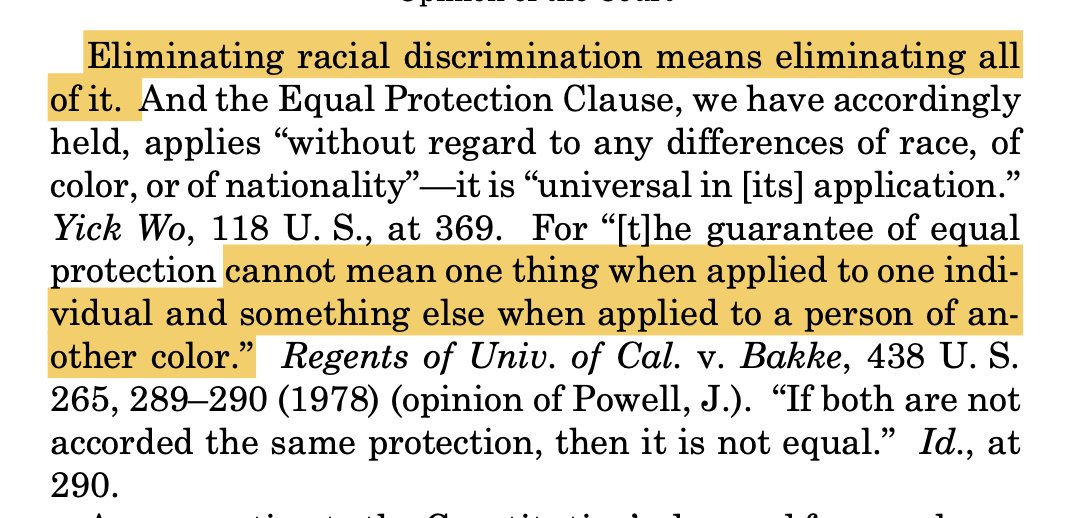
“At the same time, as all parties agree, nothing in this opinion should be construed as prohibiting universities from considering an applicant’s discussion of how race affected his or her life, be it through discrimination, inspiration, or otherwise. See, e.g., 4 App. in No. 21–707, at 1725–1726, 1741; Tr. of Oral Arg. in No. 20–1199, at 10. But, despite the dissent’s assertion to the contrary, universities may not simply establish through application essays or other means the regime we hold unlawful today. (A dissenting opinion is generally not the best source of legal advice on how to comply with the majority opinion.) “[W]hat cannot be done directly cannot be done indirectly. The Constitution deals with substance, not shadows,” and the prohibition against racial discrimination is “levelled at the thing, not the name.” Cummings v. Missouri, 4 Wall. 277, 325 (1867). A benefit to a student who overcame racial discrimination, for example, must be tied to that student’s courage and determination. Or a benefit to a student whose heritage or culture motivated him or her to assume a leadership role or attain a particular goal must be tied to that student’s unique ability to contribute to the university. In other words, the student must be treated based on his or her experiences as an individual—not on the basis of race. Many universities have for too long done just the opposite. And in doing so, they have concluded, wrongly, that the touchstone of an individual’s identity is not challenges bested, skills built, or lessons learned but the color of their skin. Our constitutional history does not tolerate that choice.”

Moving forward, it is very likely that legacy admissions will be terminated at many selective colleges as soon as the 2023-2024 admissions cycle. College leaders will want to do everything they can to be seen as advocating for diversity and getting rid of legacy admissions is one of the easiest ways to do so; however, the results of such a move may ultimately benefit Asian and White applicants far more than Black and Hispanic students if selective colleges adhere to the law/Supreme Court majority opinion and refrain from considering race when making their admissions decisions if applicant pools to these colleges and universities remain similar to what they are today.

Meanwhile, this section of the majority opinion not only goes for the jugular against affirmative action as currently practiced by selective colleges and universities, but also the entire DEI superstructure of these institutions:

Watch below for live-streamed details and analysis as it happened on June 29, 2023:

First Impressions of Digital SAT

Posted on June 12, 2023 by Score At The Top

This article by Susan Kehl was originally published at ScoreAtTheTop.com on May 31, 2023.

You’ve likely heard that College Board is shifting the SAT to a digital format, and the transition has already begun. But questions abound: When the digital SAT will be fully available? How have the first international tests fared? What will the change mean to future test-takers?

College Board touts the changes as ‘”student and educator friendly,” emphasizing that the digital SAT is “easier to take, easier to give, and more relevant.” When College Board initially test-piloted the digital SAT, 80% of students surveyed said they found it less stressful than the paper version, and 100% of educators reported that the digital SAT was a positive experience.

The SAT will be fully digital in the U.S. by 2024, while the PSAT will be administered digitally beginning in fall 2023. The SAT is already being administered digitally to international students.

Judi Robinovitz, a Certified Educational Planner specializing in educational counseling, says initial feedback has been encouraging.

“Transitioning from a paper-and-pencil test to a fully digital version has been a monumental undertaking for College Board, but several pilot sessions helped them work out the kinks and refine the process,” she said. ”A majority of test-pilot students – as well as international students who recently took the actual digital SAT – have said the test went smoothly.”
Changes and New Features

The digital SAT will still be scored on a 1600 scale, and will still be given in schools or official test centers with proctors supervising the process. It still tests students on the knowledge and proficiencies that measure college readiness and success. A few aspects of the test, however, will be changing – for the better.

While transitioning to a digital format, College Board considered input from educators and students to help streamline the test and make it more relevant. Among the changes and new features are these:

  • The digital test is shorter – lasting about two hours, compared to three for the traditional SAT.
  • Students will have more time per question.
  • Reading passages are shorter, with only one question per passage.
  • The digital SAT has two sections: Reading and writing, and math. There’s a 10-minute break between sections.
  • The digital SAT is multistage adaptive, which means the test adapts to provide each student questions appropriate to his or her test performance level.
  • Students will receive their scores in days rather than in weeks.
  • Calculators are permitted for the entire math section. Students can bring their own or use the Desmos graphing calculator that’s built into the digital testing application.
  • The digital SAT will be readily available, regardless of a student’s access to technology. Students can take the test using their own test-compatible laptops or tablets, or use a school-issued device. If necessary, College Board can provide a device on test day.
  • Students should arrive with their devices fully charged, but devices can be plugged in and charged if necessary. If computers must be restarted, students can pick up where they left off – all work will be saved, and students won’t lose test time.
  • The Bluebook testing app times each student individually, so students may start the test, take their breaks, and complete the test at slightly different times. The break isn’t mandatory – students can keep working if they prefer.
  • Students needing accommodations will find many accommodations built into the Bluebook app, such as a text magnifier to enlarge the font size.

In addition to the in-app Desmos calculator, the digital SAT offers several useful tools including:

  • Answer Eliminator: Similar to crossing out options with a pencil and paper, students can eliminate answers on-screen with the answer-eliminate feature.
  • ‘Mark for Review’ Flag: Allows students to ‘flag’ challenging questions, move on with the test, and easily revisit flagged questions later. Students can instantly see how many they’ve marked for review instead of having to flip through pages as with the paper version.
  • Timer: Students don’t have to watch the clock – an in-app timer shows a countdown of the time remaining to keep them on pace. Students can minimize or even hide the timer if it’s distracting.
  • Reference Sheet and Annotation Features: Students can use the reference sheet tool to access a list of common formulas for the math section, and can highlight any part of a question and leave notes throughout the test with the annotation tool.

How did the first Official International Digital SAT Go?

During a recent 2023 National Test Prep Association Summit, host Sonia Muthalia of Informed Decisions and Megan Stubbendeck of ArborBridge summarized feedback they received from students who took the first official international digital SAT, administered in March 2023. The general consensus is that the tests went smoothly, were efficiently administered, and students had a positive experience.

Here’s a summary of some of the general observations and opinions reported, as well as a few practical pointers and ‘takeaways’ for future test takers:

  • Smooth Sailing: Most students agreed that the test went smoothly and said they didn’t feel added stress or anxiety due to the digital format – even when minor issues arose. Overall, students reported feeling less stressed and more relaxed because the test was shorter than the paper version and they had more time per question. Take Away: The new format didn’t seem to add to student test anxiety during the initial digital SATs.
  • Small Glitches Weren’t Disruptive: Although a few of the surveyed students experienced minor connectivity issues or other slight glitches, they said issues were immediately resolved and did not affect their ability to take the test. Students who lost connectivity were able to quickly continue without losing time. Most importantly, when one student had an issue, it did not disrupt other students taking the test. Take Away: Don’t worry about tech issues – they will be resolved and won’t impact your test.
  • Hi-Tech Proctoring: Proctors have been extensively trained to assist students with the digital format, which the surveyed students said helped ease anxiety. Much of the proctoring process is also digital, so proctors can see the progress of each student including when they start when they take breaks, and when they complete the test. Take Away: Expert assistance is available – the proctors are ready, willing, and able to help.
  • The Mac is Back: In previous test pilot sessions, Mac computers weren’t compatible with the digital SAT. The issue has been resolved, and students are now able to use Mac computers. Take Away: If you have a Mac device, you can use it for the digital SAT – but it’s still a good idea to review College Board’s list of approved testing devices before test day to confirm that your device is compatible.
  • Familiar and Comfortable: Many students said they were pleased to find that the new digital SAT app felt similar to the online practice tests they’d taken through Kahn Academy and the Bluebook testing app, so it was an easy transition – most said they felt well prepared. Take Away: If you haven’t already, download Bluebook now and begin your digital SAT practice and preparation.
  • When it came to difficulty level, opinions were mixed. Some students reported that the digital SAT was comparable to the Bluebook test, while others thought the digital test was more difficult. But all students agreed that they had a positive testing experience. Take Away: Make sure you’re fully prepared for this transition to a digital format. Thorough preparation is key so that you’re ready and know what to expect.
  • Pace Yourself: Some students were surprised to discover that – due to the adaptive nature of the test – the questions in the second module were considerably more difficult than the first module, and it threw some students off on their pacing. Take Away: When taking the digital test, be prepared for the increased level of difficulty in the second module, and pace yourself accordingly (expect to spend more time answering questions in the second module than the first).
  • Practice Makes Perfect: Although the digital SAT has a built-in Desmos graphing calculator, many students said they used their own calculators instead because they felt more comfortable with their ‘trusted and reliable’ devices. Fatima, a student who provided feedback about her experience taking the digital SAT at a Bangladesh test center, used the built-in Desmos calculator and believes it saved her time and was crucial to her success during the exam. Take Away: Because using the in-app calculator can be a faster, more efficient way to find the solution, it’s a good idea to become familiar with the in-app tools – like Desmos – ahead of time so that using them is comfortable and second nature on test day. Most experts agree that it’s beneficial to use both Desmos and your own calculator during the test (depending on the problem/equation).
  • Some students, like Fatima, said they wished there had been additional Bluebook practice exams available to help prepare for and become comfortable with the digital SAT (currently there are only four practice exams in the Bluebook app). Take Away: Use the Bluebook practice exams wisely. Instead of taking all four consecutively, spread them out by using and learning from additional test prep methods like Kahn Academy, 1600.io (Fatima recommends the Math Orange Book!), and full-length practice tests. However, because there isn’t as much practice material available as with the paper-and-pencil format, it can be a challenge for students to properly prepare on their own. Working with a test-prep tutor or Independent Educational Consultant can help students learn useful test-taking strategies, and shortcuts, how to use the in-app tools, and how to efficiently navigate the digital SAT.

Rabinowitz says that although some may have initially been resistant to the idea of a digital SAT, the transition has been smooth and successful so far – and the digital version is here to stay. She believes that because the digital SAT is an entirely new platform, effective test prep is more important now than ever.

“Be sure to familiarize yourself with the functionality of the Bluebook testing app – learn how to navigate it and make use of its time-saving in-app tools,” she said. “Take full-length practice tests to acquaint yourself with the types of questions you’ll encounter on test day, and most of all – don’t let the new format intimidate you. Just remember to relax, be confident, and do your best.”

Need help to prepare for the digital SAT? Score At The Top offers the most effective standardized test preparation available. Our test-prep programs were designed by our founder, Judi Robinovitz, who not only scored a perfect SAT score on the traditional SAT – but she also worked with Educational Testing Service (the world’s largest educational testing organization) for 23 years. Join us for free test simulations, private 1:1 tutoring sessions, small group PSAT and SAT workshops, and more.

This article by Susan Kehl was originally published at ScoreAtTheTop.com on May 31, 2023.

College Admissions Consultant Red Flags

Posted on June 8, 2023 by Craig Meister Leave a Comment

After almost twenty years working in the realm of college admissions, I’ve crossed paths with a lot of people (some well-meaning, some not so much) presenting themselves as august college admissions consultants. As a result, I think it’s important that you become aware of several of the tell-tale warning signs that someone selling herself (or himself) as a quality college admissions consultant is likely anything but!

In the two videos below, I share my thoughts on how to spot a consultant I’d recommend avoiding.

>

  • « Previous Page
  • 1
  • …
  • 13
  • 14
  • 15
  • 16
  • 17
  • …
  • 47
  • Next Page »

Subscribe to our mailing list

Trending Posts

USC Expands Early Decision, Eliminates Common App Courses & Grades Section for First-Year Applicants

Early Decision applicants to make up nearly 60% of Boston University’s Class of 2028

Dear 9th Grader: Don’t get rejected from the Ivy League so soon!

Dear 10th Grader: Don’t Become An Ivy League Reject!

AP vs. IBDP. Which is best for you?

Digital SAT: All You Need to Know

Dear 11th Grader: Don’t Screw Up Your Ivy League Chances Now

Brown’s Regular Decision Acceptance Rate Now 3.8%

The top 23 songs to listen to while completing your college applications in 2023 are…

Wake Forest Introduces Exclusive Early Action (EEA)

This is what Affirmative Action and Test-Optional looks like at University of Wisconsin-Madison

8 Ways to Reduce the Cost of College

How to Deal with Anxiety During College Admissions (Especially Now)

Another Reason Why Your Common Application Essay is So Bad

Building Your Best College List

10 Best Colleges for Smart Skiers and Snowboarders in North America

Caltech to require SAT or ACT scores again

Yale Receives 1,000 Fewer Early Action Applications

5 Smart Summer Tips for Wise Rising Seniors

New Dartmouth Essay Prompts Feature Football and Wild Chimpanzees

30 Summer STEM Camps for High School Freshmen

Oh, Canada! The Definitive List of Canadian University Application Deadlines

Northwestern Releases Regular Decisions, Class of 2027 Statistics

UNC and a tale of one – make that four – acceptance rates

Making the most of the summer before senior year

Top 5 Ways Applying to US Colleges is Different than Applying to UK Universities

You CAN apply Restrictive Early Action and Early Action under the right conditions

Wesleyan University Ends Legacy Preferences in Admissions

The Perfect Gifts to Celebrate Getting Into College

Search Posts By Topic

  • 3 Year Degree (3)
  • Accommodations (3)
  • Admissions Policies (132)
  • Admissions Statistics (90)
  • Advice & Analysis (467)
  • Alabama (2)
  • Amherst (2)
  • AP (6)
  • Applications (93)
  • Applying from India (1)
  • Arizona (4)
  • Arts (1)
  • ASU (1)
  • Austin College (1)
  • Babson (1)
  • Baylor (1)
  • Berry College (1)
  • Boston College (2)
  • Boston University (6)
  • Bowdoin (2)
  • Brown (6)
  • Bryn Mawr (1)
  • Business (2)
  • BYU (1)
  • Caltech (6)
  • Canada (2)
  • Career and Technical Education (33)
  • Case Western (4)
  • China (1)
  • CMC (1)
  • Coalition (13)
  • Colby (3)
  • College Costs (1)
  • College Counselor (18)
  • College Fairs (5)
  • College Life (38)
  • College List (39)
  • College List Deathmatch (5)
  • College Visit (25)
  • Colorado College (1)
  • Colorado School of Mines (1)
  • Columbia (7)
  • Common App (42)
  • Community Colleges (4)
  • Cornell (5)
  • Counseling (3)
  • COVID-19 (8)
  • CSS PROFILE (3)
  • CSU (1)
  • CSULB (1)
  • CU Boulder (2)
  • Cybersecurity (1)
  • Dartmouth (7)
  • Davidson (1)
  • Demonstrated Interest (17)
  • DePaul (1)
  • Dickinson (1)
  • Direct Admissions (1)
  • Duke (3)
  • Early Action (44)
  • Early Childhood Education (1)
  • Early Decision (46)
  • Education (6)
  • Educational Consulting (1)
  • Elon (2)
  • Emergency Management (1)
  • Emory (1)
  • Engineering (3)
  • Enrichment (18)
  • Entrepreneurship (2)
  • Environmental Science (2)
  • Essays (58)
  • Europe (7)
  • Exercise Science (1)
  • Exeter (1)
  • Experiential Learning (1)
  • Extracurricular Activities (37)
  • FAFSA (6)
  • Feature (2)
  • Financial Aid (31)
  • First Person (13)
  • Fly-In (1)
  • France (1)
  • FSU (1)
  • Gap Programs (2)
  • GED (1)
  • Georgetown (5)
  • Germany (2)
  • Gifts (3)
  • Gonzaga (1)
  • GPA (7)
  • Graduate School (11)
  • Hamilton (1)
  • Harvard (7)
  • Healthcare (3)
  • High School (25)
  • Higher National Diplomas (1)
  • HiSET (1)
  • IB (4)
  • IEC (1)
  • IELTS (1)
  • Indiana (3)
  • Industrial Hygiene (1)
  • International (9)
  • Internships (8)
  • Interviews (10)
  • Iowa (2)
  • Italy (2)
  • Ivy League (20)
  • JHU (3)
  • Journalism (2)
  • Kettering University (1)
  • Lafayette (1)
  • Law (4)
  • LD (1)
  • Lists & Rankings (8)
  • Loans (1)
  • Majors (17)
  • Marketing (1)
  • Math (1)
  • Medicine (1)
  • Mental Health (3)
  • Middlebury (1)
  • MIT (7)
  • Montana State University (1)
  • Moving (1)
  • Naviance (2)
  • NCAA (3)
  • New Mexico State University (1)
  • News (127)
  • Northwestern (5)
  • Notification News (4)
  • Notre Dame (3)
  • Nursing (13)
  • NYU (3)
  • Of Note (17)
  • Ohio State (2)
  • Oklahoma (1)
  • Online Learning (15)
  • Open Admission (2)
  • Parents (7)
  • Penn (8)
  • Pharmacy (1)
  • Pitt (2)
  • Popular Posts (10)
  • Princeton (5)
  • Priority (2)
  • Professor of the Month (1)
  • PSU (3)
  • Psychology (3)
  • Public Universities (8)
  • Purdue (3)
  • Rankings (11)
  • Reader Questions (11)
  • Recommendations (10)
  • Regular (26)
  • Research (4)
  • Resume (20)
  • Rice (4)
  • Robotics (1)
  • Rochester (1)
  • ROI (4)
  • Rolling (5)
  • Rose-Hulman Institute of Technology (1)
  • Santa Clara University (2)
  • Scholarships (2)
  • SEL (1)
  • Sewanee (1)
  • Skiing & Snowboarding (1)
  • SMU (1)
  • Social Work (7)
  • Soft Skills (1)
  • South America (2)
  • Southwestern (TX) (1)
  • Spotlight Series (1)
  • SRAR/SSAR (1)
  • St. Edward's University (1)
  • St. John's College (1)
  • Standardized Tests (44)
  • Stanford (4)
  • STEM (2)
  • Stevens Institute of Technology (1)
  • Student Trips (1)
  • Summer (24)
  • Swarthmore (1)
  • Syracuse (1)
  • TASC (1)
  • Teacher Recommendations (8)
  • Temple (1)
  • Texas (4)
  • Texas A&M (1)
  • Ticker (26)
  • Trending Posts (46)
  • Trinity University (TX) (1)
  • Tufts (5)
  • Tuition (3)
  • Tulane (8)
  • UBC (1)
  • UC Berkeley (8)
  • UC Davis (2)
  • UC Santa Barbara (2)
  • UCAS (5)
  • UCF (1)
  • UCI (1)
  • UCLA (8)
  • UCSD (1)
  • UDub (1)
  • UF (4)
  • UGA (3)
  • UIUC (3)
  • UMass (3)
  • UMD (5)
  • UNC (2)
  • United Kingdom (8)
  • Universal College Application (1)
  • University of Chicago (3)
  • University of Dallas (1)
  • University of New Mexico (1)
  • University of Rochester (1)
  • University of Vermont (1)
  • USC (5)
  • USNA (1)
  • UT Austin (4)
  • Utah (2)
  • UVA (7)
  • Vanderbilt (2)
  • Video Game Design (1)
  • Villanova (3)
  • Virtual Information Session (1)
  • Virtual Visit (2)
  • Wake Forest (1)
  • Wash U (7)
  • Wesleyan (2)
  • Williams (3)
  • Wisconsin (3)
  • Work Study (1)
  • Yale (14)
  • ZeeMee (1)

News Tips | Write for Us | Sponsored Posts
All content © 2025 | Admissions.Blog
Terms of Service | +1 410-526-2558

Copyright © 2026 · Metro Pro Theme on Genesis Framework · WordPress · Log in